Nyelele Group
UVA Department of Environmental Sciences
Urban Forestry
Climate Resilience Strategies in Urban Forestry and Green Spaces
Dr. Charity Nyelele
Summary
The Nyelele group focuses on research informing the development of community-based strategies to address climate, environmental, and societal concerns. I am currently designing a survey assessing public opinion on climate resilience strategies through Charlottesville green spaces. Additionally, I am co-authoring a publication evaluating historical factors impacting the effectiveness of urban tree planting initiatives within 15 U.S. cities.
I previously analyzed environmental policies in New York City from the local, state, and federal level.
Skills
- Literature review: critical analysis of scientific literature containing satelite imaging
- Environmental policy analysis: NYC Parks and Recreation, NY State regulations, Federal regulations
- Software: Python (basic), GIS (basic), Qualtrics, Canva
Atlanta: case study on environmental impact of history
In my review of tree planting initiatives, I established Atlanta as a case study for how a city’s history impacts their current urban climate. In most cities, marginalized communities have a lower volume of tree canopy compared to affluent areas due to redlining, a historical practice. However, Atlanta, during the 1960s-70s, experienced a migration of white, affluent residents from their neighborhoods due to integration. This caused marginalized African American residents to move into the now vacant affluent areas. In Atlanta, tree canopy issues are evident in both overall canopy volume and lack of care to current trees.
History and context are important. Planting initiatives must take into consideration the unique history of their location. Atlanta planting initiatives should focus on caring for existing trees in marginalized communities, as opposed to solely increasing canopy volume.
Source of funding proves complications
In my review of environmental policies in New York City and other metropolitan cities, I determined a major barrier to success in initiatives is the source of funding.
“An ongoing planning process, including…deficiencies in existing planning and in the
Urban Park and Recreation Recovery Act of 1978, Section 50
capability of the community…Extent to which current park and recreation planning is integrated with overall community planning or would be better integrated as a result of the grant.”
The quote above refers to requirements that must be met in order for environmental plans to qualify for grant money set aside in the Urban Park and Recreation Recovery Act of 1978. This is just one of the examples of the complex barriers, or “red tape” that may inhibit the success rate of urban forestry policies.
I analyzed tree planting initiatives across 15 U.S. cities and identified source of funding as an inhibitor. While government funding may be difficult to obtain due to bureaucratic “red tape,” mixed public-private funding also results in mixed results. In New York City, their MillionTrees initiative was met with success. However, Los Angeles was not. This indicates that even private sources of funding may impact the success of environmental initiatives.
Positive language in policies
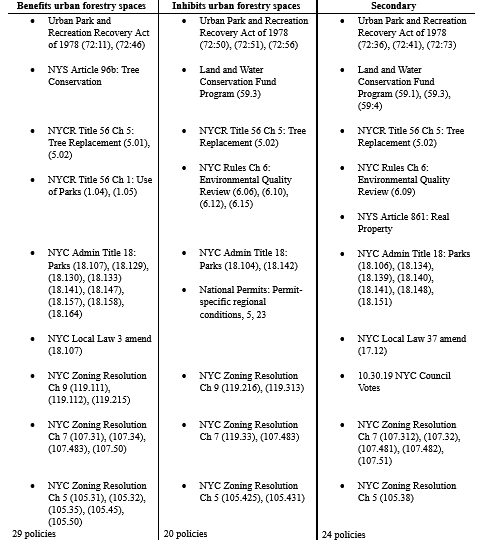
A table of the relevant policies I found related to forested spaces in New York City.
I identified key words that indicate tree planting as favorable in NYC Parks and Recreation policies. Policies that emphasize the public health benefits of trees and prioritize maintaining the existing volume of tree canopy in the area of interest were positively connotative to supporting an increase in urban tree canopy of New York City.
Timeline Graphic
In my first semester of research with the Nyelele group, one of my goals was to create a historical timeline of the policies related to the regulation of forested spaces in New York City. The timeline is available for download below.
Internal Report
My work was summarized in both a summary report for academic credit, as well as a more detailed internal report. The internal report is attached below.
 Sarah Fong